Coming 2026 · Popular Science

Climate Change:
Earth's Headache

Global Stories and Everyday Wisdom for a Warming World

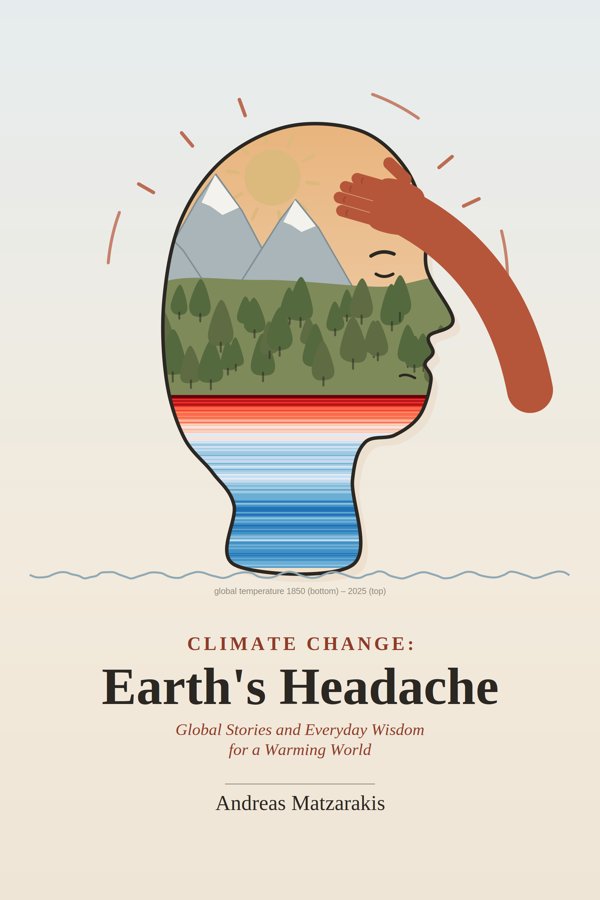
Book cover: a head in profile holding its forehead, filled with mountains, forest and warming stripes

Many people know the headache that comes with a sudden change in the weather. Climate change is the Earth's own headache — and like any headache, it can be eased. In sixty‑nine chapters, from Ahmedabad to the Arctic and from Persian ice houses to Japanese street watering, this book tells how people around the world live with heat, water, fire and storm — and what everyone can do.

PDF coming soon
01

What the Book Covers

  1. I

    Understanding the problem — what climate change feels like in the body, the greenhouse effect, extreme weather and who is hit hardest.

  2. II

    Heat — urban heat islands, Ahmedabad's heat action plan, Paris after 2003, trees, parks and cooling without air conditioning.

  3. III

    The vanishing cold — why poles and mountains warm faster, Shishmaref, Ladakh's ice stupas, glaciers, permafrost and winter cities.

  4. IV

    Everyday wisdom — ventilating a home, uchimizu, tree shade, zeer pots, Persian ice houses, siesta, qanats and climate godparents.

  5. V

    Water — Cape Town's Day Zero, the Netherlands, cyclone shelters in Bangladesh, Pacific islands and protecting property.

  6. VI

    Feeding a warming world — shifting seasons and crops, farming in the Sahel, traditional irrigation, waru waru, wine and coffee on the move.

  7. VII

    Fire and storm — living with wildfire, Indigenous burning in Australia, building back better after storms.

  8. VIII

    Ecosystems under pressure — mountains, forests, deserts and oceans — from Kilimanjaro and the Black Forest to coral reefs and Arctic sea ice.

  9. IX

    The human side — climate anxiety, weather-sensitive bodies, headache and migraine, vulnerable groups and migration.

  10. X

    Cities and communities — cool and green roofs, local heroes, Phoenix's heat relief network, heat-health action plans and C40.

  11. XI

    The bigger picture — policy explained simply, everyone's part, a reader's toolkit, climate education, mitigation and adaptation.
02

Questions the Book Answers

03

Why It Is Different

The book is written for everyone — no special background needed. Each chapter starts from a real place and real people: a village in Alaska that has to move, farmers in the Andes who revive an old way of planting, a city that learned from a deadly summer. It is honest about the problem and generous with solutions.

Old wisdom, new tools. Many of the best answers to heat and drought are centuries old — shade, water, thick walls and a rest at midday. The book shows how this knowledge, together with modern science, helps us live well in a warming world.

Cover: warming stripes (one stripe per year, 1850–2025, bottom to top) based on NOAA GlobalTemp data, after Ed Hawkins (#ShowYourStripes).

04

The Author

Prof. Dr. Andreas Matzarakis works in environmental meteorology at the University of Freiburg and Democritus University of Thrace. He led the Centre for Medical-Meteorological Research of the German Meteorological Service (DWD) in Freiburg until 2024 and has taught on climate change since 1993. His work on human biometeorology, urban climatology and tourism climatology gave rise to the RayMan model and the modified thermal index mPET.

67 chapters + prologue + epilogue·11 parts·≈ 270 pages·6 × 9 in·richly illustrated
Will be freely available as a PDF·Licensed under CC BY‑NC‑ND 4.0·ISBN to be assigned
The PDF will be linked here when the book is published

Prof. Dr. Andreas Matzarakis, University of Freiburg
andreas.matzarakis@meteo.uni-freiburg.de · www.matzarakis.de